Medical Education
Medical education is a core part of being a respiratory clinician. It includes teaching, supervising, assessing, and helping shape the learning environment for future healthcare professionals. The Respiratory Curriculum outlines the key knowledge, skills and behaviours trainees need to demonstrate before CCT so they can contribute confidently to a strong educational culture.
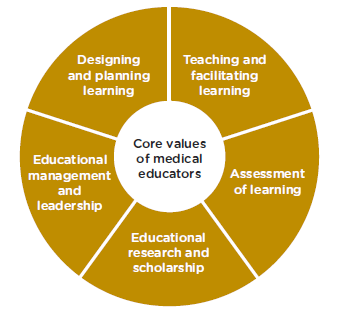
Image courtesy of the Academy of Medical Educators
Training in Medical Education
Trainees are strongly recommended to complete training in teaching skills. Short 1-2 day courses are available from the Royal College of Physicians and the Royal Society of Medicine.
If you would like to build deeper expertise, you can pursue a qualification such as a PGCert, Diploma or Masters in Medical or Clinical Education. These are offered full‑time, part‑time or via distance learning by providers including the Royal College of Physicians and many UK universities.
You may also choose to have your skills formally recognised through a specialist body, such as Advance HE.
OOPE Opportunities in Medical Education
You can use Out of Programme (OOP) time to develop as a medical educator, just as you would for research. Many trainees take up clinical teaching fellow posts, which often include support toward educational qualifications like a PGCert or Diploma.
These roles vary widely and may be based in:
- Hospital trusts
- Medical schools
- Royal College of Physicians (RCP) policy units
- Health Education England (HEE)
Plan ahead: most programmes only allow OOP exits in April or October, and you must usually give six months’ notice to your TPD.
Read more about Clinical Teaching Fellowships | BMJ
The Future of Medical Education
The GMC expects all doctors to demonstrate skills in teaching and training, but recognises that some will take on specialist education roles. They have defined four trainer roles that require recognition:
Postgraduate
- Named Educational Supervisor
- Named Clinical Supervisor
Undergraduate
- Lead coordinators of training at each education provider
- Doctors who oversee student progress at each medical school
If you are considering becoming an educator long‑term, review these requirements early. It can be helpful to speak with your Director of Medical Education, Postgraduate Dean, or Head of School to explore opportunities that support your development toward CCT.